|
|
|
Hiking Information
Rocky Mountain National Park is a park for hikers. More than 355 miles of trails provide access to remote areas of the park so you can escape the crowds and savor the streams, meadows, and mountains. Because great numbers of people visit the park in the summer, some trails are heavily used. To avoid congestion, ask a ranger to suggest lightly used trails.
For on-your-own learning experiences, the park offers self-guided trails. Pick up a folder describing features along these trails at the trailhead or at a visitor center.
All distances are one way unless listed as a loop and in miles and elevations are in feet.
| Trail | Distance | Elevation | Description |
| Bear Lake Nature | 0.6 Loop |
9,475 | An excellent interpretive nature trail circles this popular subalpine lake at the end of Bear Lake Road |
| Lulu City | 7.2 | 9,300 | Only traces of log cabins remain of a once booming mining town |
| Moraine Park Nature | 0.25 | 8,000 | This easy stroll helps you identify local plants and animals |
| Never Summer Ranch | 1.0 | 9,000 | The landscape and cabins tell the story of early 20th - century homesteading and dude ranch life |
| Sprague Lake Nature | 0.5 | 8,710 | This level walking trail is ideal for visitors with disabilities |
|---|---|---|---|
| Tundra World | Short | 11,600 - 12,210 | Short trails lead from both the Forest canyon and Rock Cut overlooks |
| Trail | Trailhead | Length | Description |
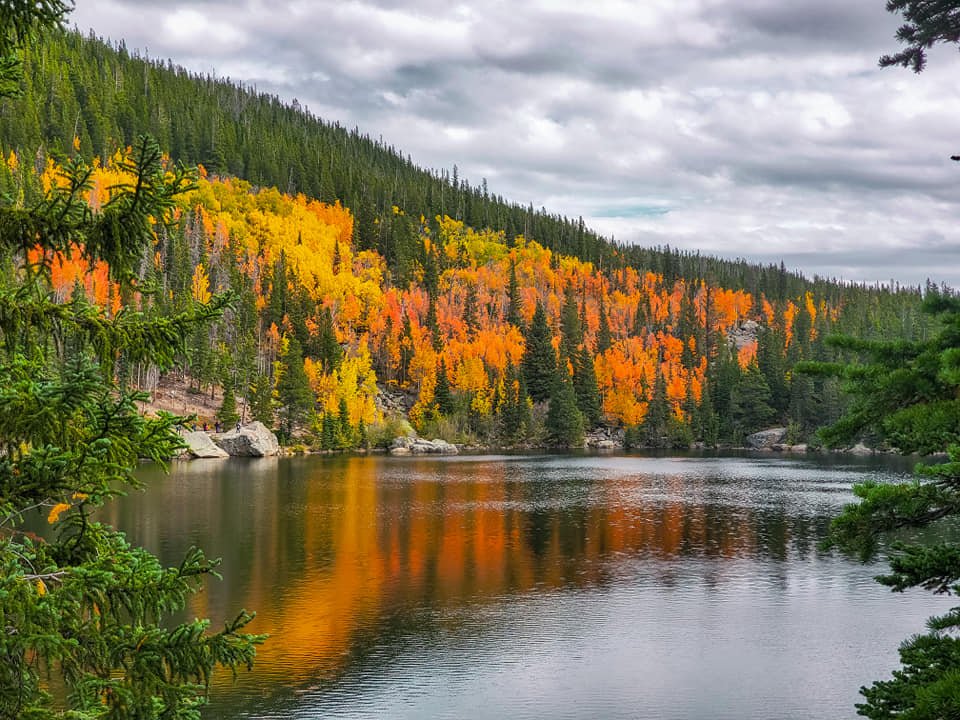
| Bear Lake Nature | Bear Lake | 0.6 mile-loop | Easy; This stroll around an alpine lake tells the story of glaciation and subalpine life |
| Cub Lake | Cub Lake | 2.3 miles | Moderate; A park favorite, this hike to a mountain pond travels through woods that blaze with color in the fall |
| Mills Lake | Cub Lake | 2.3 miles | Moderate; The view of Longs Peak and the Keyboard of the Winds from Mills Lake is one of Rocky Mountain's finest |
| Bluebird Lake | Wild Basin | 6.0 miles | Strenuous; This long hike to a scenic lake includes a trip through a recovering, fire-charred forest and stops at Ouzel Falls and Ouzel Lake |
| Lone Pine Lake | East Inlet | 5.5 miles | Strenuous; Streamside hiking past Adams Falls and wonderful scenery highlight this west side lake hike |
| Trail | Trailhead | Length | Description |
| Deer Mountain | Deer Ridge Jct | 3.0 | Moderate; Fine views, pleasant hiking and a picnic on top make this trip a hiking favorite.Summit elevation 10,013 |
| Sundance Mountain | Trail Ridge Road | 0.5 | Moderate; This high-altitude walk to this summit begins on Trail Ridge Road between Forest Canyon Overlook and Rock Cut; Summit elevation 12,466 |
| Twin Sisters Peak | Twin Sisters | 3.7 | Moderate; These two peaks sit off by themselves to the east, offering outstanding vistas sweeping in all directions. Elevation at summit 11,428 |
| Flattop Mountain | Bear Lake | 4.4 | Strenuous; Panoramic views and access to many other great peaks lure hikers up this mountain in the middle of the park. Summit elevation 12,324 |
| Mount Richtofen | Colorado River | 7.2 | Very Strenuous; This peak is one of the prominent summits in the beautiful, remote and exciting Never Summer Mountains; Summit elevation 12,940 |
| Trail | Trailhead | Length | Description |
| Adams Falls | East Inlet | 0.3 | Easy; A beautiful stream and pleasant scenery accompany hikers on this popular west side walk |
| Alberta Falls | Glacier Gorge Jct | 0.6 | Easy; Glacier Creek thunders down this spectacular waterfall that ranks as one of the park's more popular hiking destinations |
| Cascade Falls | North Inlet | 3.5 | Moderate; The hike through forested country ends with a scenic respite beside this tumbling waterfall on the park's west side |
| Quzel Falls | Wild Basin | 2.7 | Moderate; Watching the falls' namesake, the ouzel, or dipper, plunge into the rushing streamwater entertains hikers at this popular spot |
| Timberline Falls | Glacier Gorge Jct | 4.0 | Strenuous; Scenic Loch Vale is enjoyed en route to these delicately beautiful falls on the park's east side |
Winter Hikes
East of the Continental Divide
Winter brings deep snows to Rocky Mountain National Park west of the Continental Divide. Lighter snowfall on the east side of the park leaves low elevation trails open for hiking. Trails below 8,700 feet (2,700 m) offer diverse opportunities to those who wish to travel without the aid of skis or snow shoes. The trails listed below are some of the more accessible hikes available to winter visitors. Before each outing, check with park rangers for local snow conditions and current avalanche hazards. The distances listed for the following hikes are one-way.
All distances are in miles / kilometers and elevations are in feet and meters.
| Hike | Distance | Difficulty | Elev Gain | Trailhead | Description |
| Chasm Falls | 2.5 / 4.0 | Moderate | 400 / 120 | West Alluvial Fan parking lot | Hike 1.5 miles to junction of Endovalley Rd and Old Fall River Rd. You will pass cabin remains. At road jct take right fork and continue up Old Fall River Rd 1.0 mile to falls. Negotiate this zone with caution |
| Cub Lake | 2.3 / 3.7 | Moderate | 540 / 165 | Trail begins in willow thickets along Big Thompson River | You pass through a varied landscape of moraines, cliffs, streams and ponds. Ice or deep snow may make the last mile difficult, and may require skis or snowshoes |
| Deer Mountain | 3.0 / 4.8 | Strenuous | 1,075 / 325 | Deer Ridge Jct from Park Headquarters drive 4.5 miles on Hwy 36 to roadside parking | The route up Deer Mountain begins in a stand of mature ponderosa pine and winds upward past lodgepole pine, aspen, and limber pine to the summit plateau. Spectacular views of the Continental Divide. Snow cover on summit may be 3-5 ft deep |
|---|---|---|---|---|---|
| Gem Lake | 1.8 / 2.9 | Moderate | 910 / 275 | Parking lot off road for MacGregor Ranch | The shallow waters of Gem Lake are cradled high among the rounded granite domes of Lumpy Ridge. Untouched by glaciation, this outcrop of 1.8 billion-year-old granite has been sculptured by wind and chemical pillars, potholes, and balanced rocks |
| The Pool | 2.5 / 4.0 | Easy | 200 / 60 | Follow signs to Fern Lake Trailhead | The pool is a turbulent water pocket formed below the confluences of Spruce and Fern Creeks with the Big Thompson River. Look for beaver-cut aspen, frozen waterfalls on the cliffs, and the Arch Rocks |
| Upper Beaver Meadows | 1.5 / 2.4 | Easy | 140 / 43 | Upper Beaver Meadows Rd | There are 2 hiking route - the road that winds along the north side of Beaver Creek for 2.0 miles, and a trail that leaves the dirt road on the left just inside the barricade. The trail crosses the stream and runs along the south side of the meadow at the base of moraine. The trail and road meet at the parking lot at the west end of Beaver Meadow |
Hiking Safely
Winter in Rocky Mountain National Park is an inviting yet silently dangerous time for hikers. The season brings short days with strong winds, low temperatures, and rapidly changing weather. Be prepared for these conditions by carrying extra clothing for layering, as well as water and high energy food.
Prevent frostbite by keeping your extremities and face well protected. Watch for the first warning signs of frostbite, a tingling, then numbing feeling.
Avoid hiking in deep snow which is quickly fatiguing and creates hazardous holes for skiers and snowshoers who follow. When conditions are icy, use instep crampons or ski poles for extra safety.
Hiker Extraordinar Randal W. Horobik
Overview
Hiking in Rocky Mountain National Park features all the usual things folks expect from an alpine locale: breathtaking views of jagged mountains, lush alpine meadows and tundra, cascading mountain streams and cool pine forests. Wildlife abounds in the park as well--moose, elk, deer, marmots, beaver, pika, mountain lion and bighorn sheep abound. For bird watchers, the diversity of ecosystems within the park presents a smorgasbord of viewing opportunities. Also present within park boundaries are glimpses of history and remnants of the mining background that helped build much of the early history of the area around the park.
Hiking in RMNP is a pleasure for both the avid backpacker and the day-hiker. What follows are a selection of my favorite destinations, discovered during the course of several summers of logging foot miles in the park. Hiking trails, like roads, are prone to changes and the occasional re-routing. While I have endeavored to keep mileages and descriptions accurate to the way things are at present, changes may take place, closing off a section of trail, a camping site, or throwing mileages off. In most cases any changes will be minor at best, but local inquiry should always be the rule before a hike. This guide was written with the intent of being a starting point, not the final word on a destination.
Hiking season in RMNP varies greatly from year to year based on weather conditions. I, personally, have accessed lower altitude trails, such as the one to Cub Lake, in mid-April and late October and found them relatively clear from snow. I have also had attempts to climb Longs Peak halted due to mid-July snowstorms. May to September is the typical hiking season for most park trails.
If you are curious about trail conditions, a stop at the Visitor's Center just inside the park's eastern boundary on U.S. 36, is well worth the time. The Information desk typically has a journal of trail conditions during the spring and fall months and will be able to tell you if a trail is clear for hiking. Conversely, if you hike a trail during the spring or fall months, please stop in at the Visitor's Center and tell the ranger on duty what trail you hiked, what the conditions were, and where on the trail you encountered significant snow cover. Such reports are invaluable to future hikers wondering about the same area.
First, not all of RMNP's best locales are found on a trail. Breathtaking places, such as the Spectacle Lakes, can only be viewed by going off trail. While off-trail travel is not illegal in the park, it does present the hiker with added dangers. I have purposely omitted references to all but one off-trail location to force those wishing to access such sites to inquire locally or to purchase detailed maps of the area. Stay on the trails, they have been constructed for both your safety and your convenience, as well as to prevent erosion or damage to the landscape.
Second, be aware of the sky at all times. Many of RMNP's trails take the hiker above timberline in this alpine setting. Thunderstorms are very frequent during the late spring and summer months and tall puffy cumulus clouds that forbode such storms are a common sight by 2 PM in the afternoon. Plan your hikes so that you can be on your way back down towards tree line by early afternoon. If you see lightning or hear thunder, break off any hike that you are one and retreat to below tree line as quickly as possible. If you are caught above tree line in a thunderstorm, discard any metal frame backpacks, stay low to the ground and at all costs avoid standing under lone trees or being the tallest point around. Retreating down to tree line should always be your strategy. Every summer a few mishaps occur because hikers didn't have the common sense to turn back when dark thunderstorms began forming.
Finally, hypothermia is also a threat when hiking in RMNP. Dress appropriately and keep in mind that a trailhead might be 70 degrees with no wind, but atop the mountains, it might only be 45 with a strong breeze. Always pack some extra layers of clothing and be alert to uncontrolled shivering in your hiking companions.
Lost Falls / Lost Lake (7.7 miles to the Falls, 9.7 to the Lake)
This is a beautiful two-day hike through the rarely-used northeast corner of the park. To find the trailhead, take Devil's Gulch Road from the town of Estes Park (inquire locally if you have trouble finding it). Take the road through the tiny town of Glen Elder and then approximately two miles further north. A forest access sign will point you left down unpaved Dunraven Glen Road. There, a parking area on the left and trailhead on the right of the road will be your destination.
From here, it is a 4.4 mile hike just to reach the National Park boundary -- one reason the trail is overlooked by many. In August and September, look for fresh wild raspberries growing along the trail. Keep in mind that parts of the early trail occupy private land, so please stick to the trail. Three miles from the trailhead, you will reach Deserted Village, still outside the park. This was an early turn-of-the-century hunting resort for the wealthy. It floundered around 1909 and closed its doors for good in 1914, one year before the park was founded. One cabin still stands and the remnants of others are visible. Also, somewhere in this section of trail, the Scottish Lord Earl Dunraven supposedly buried a cache of whiskey one fall, with the intent to unearth it the following spring when he returned. The cache, however, was never found and possibly remains buried to this day. In the event of emergency, be aware that a patrol cabin exists 5.4 miles from the trailhead, about 200 yards or so to the left at the junction of the Boundary Trail.
Lost Falls, a four-stage cascade, lies just off the trail some 7.7 miles from the trailhead. The last time I hiked the trail, you couldn't actually see the falls from the trail. To get a vantage point, break left from the trail at the junction with the Mummy Peak trail and follow your ears to the water. Lost Lake lies another two miles up the trail. There are seven campsites to select from along this trail--a high number considering the relatively low use of this area of the park. I recommend Sugar Loaf or Lost Meadows. Check at the Visitor's Center for campground regulations...stoves-only are the rule at some backcountry campsites.
Lawn Lake / Crystal Lake (6.2 miles to Lawn, 7 miles to Crystal)
Take the Fall River Road turnoff from US 34 and its only a few hundred feet before the Lawn Lake trailhead parking lot appears to the right. Lawn Lake will forever be part of RMNP history following an incident on July 15, 1982. On that day, an early 1900s dam at Lawn Lake gave way, allowing tons of water to rage downhill. That flood created the alluvial fan, visible just west of the trailhead down Fall River Road. Three campers lost their lives as a result of the accident.
After a steep, switchback climb from the parking area, you get your first glimpse of the gouge this torrent of water cut through the earth. You will also get to see a glimpse of the erosion damage caused by hikers who cut switchbacks--please stay on the trail and remind others to do the same.
Staying on the trail has more than the usual meaning on the route to Lawn Lake. Much of the trail borders the chasm created by the flood of 1982. To this day, the ground along the edges of the gully remains unstable and prone to sudden slides. Sections of the old pre-flood trail have been re-routed to avoid some of the more unstable and undercut areas. Staying on the new (marked) trail is an easy way to avoid adding to the flood's casualty total.
The trail reaches a junction after 5.5 miles or so. Bearing left will get you to the lakes. At Lawn Lake, the sparsely vegetated area around the edge of the lake shows the difference between pre-flood and post-flood water levels. Many hikers turn around at Lawn Lake, but the extra 0.8 miles to get to Crystal Lake are well worth it. Crystal is believed to be the deepest lake in the park, and with the cliff face of Mount Fairchild in the background, makes an excellent photo opportunity.
Fall River / Chasm Falls (2.2 miles from Endovalley)
This isn't actually a trail, but a road. I include it in the hiking section, however, because Fall River Road is only open from 04 July to Labor Day most years, meaning that for many, the options are either to walk this section of the road or miss Chasm Falls altogether. If the road is open, however, do not hike to Chasm Falls, rather, drive. Hiking while the road is open creates a traffic hazard for those driving the route.
If you can park at the Endovalley Picnic area, do so. The picnic area is rarely used during the months that Fall River Road isn't open, so parking there usually isn't a problem. If not, you'll have to park at the Alluvial Fan, which will add 1.5 miles or so to your distance. Keep in mind as you walk up the narrow switchbacks that the Fall River Road is the original road through the park and that folks used to drive BOTH ways on its surface. Today, mercifully, it is a one-way, uphill road to vehicle travel, when open.
Hiking up Fall River Road gives a tremendous view down the Fall River Valley. Chasm Falls, your typical alpine cascade, makes a charming picnic destination. Surprisingly, few folks think of taking this walk during the months Fall River Road is closed, thus it is also an easily-accessible day hike that has the added luxury of being free from crowds.
Cub Lake (2.3 miles)
Off Bear Lake Road, follow the turnoff to the Moraine Park Campground, then bear left just before the grounds to follow a road back to the trailhead. Parking for Cub Lake is limited, if the lot is full, continue just 0.2 miles further down the road to the larger Fern Lake trailhead parking lot and walk back).
Hiking to Cub can be hot in mid-summer and mosquitoes can also be a bother, therefore, this hike is one to consider for early in the season. The Cub Lake Trail is an elk-watchers paradise in the spring and fall, especially in mid-afternoon. Bird watchers will love the trail as well. The walk is a relatively easy one, encountering just a few switchbacks and a moderate climb up to Cub Lake. Nearby Fern Lake is also well worth the 4 mile hike, featuring interesting rock formations and a pair of waterfalls along the length of its trail. If you had to park at the Fern Lake trailhead, consider continuing down the trail when you arrive at Cub Lake. The trail will descend over the next 0.8 miles, connecting with the Fern Lake trail, where a 1.6 mile walk down the right fork will get you back to your vehicle and allow you to see the rock formations along that trail as well.
Albert Falls / The Loch (0.6 miles to Alberta Falls, 2.7 to The Loch)
In terms of photographic beauty, few lakes in RMNP will compare to The Loch. When distance and difficulty of the hike are figured into the equation, The Loch is nearly unequaled. Unfortunately, the trailhead lies down Bear Lake Road in the park, which has become a traffic nightmare during the summer months. A free shuttle bus operates down Bear Lake Road during the summer and is an excellent way to both avoid having to drive in the traffic on Bear Lake Road and also avoiding contributing to the traffic problem.
If you are determined to drive to the trailhead, I can only offer this advice--get an early start. The Glacier Gorge trailhead which leads to The Loch is *very* small and is typically full by 9:00 am. Once the lot fills, you're left with no choice but to drive up to the Bear Lake parking area which has, itself, been filled to capacity in recent summers, despite a recent expansion. A trail connects the Bear Lake lot to the Glacier Gorge trailhead, but adds 0.4 miles each way. Please, consider the bus.
Alberta Falls is an easy hike along flat trail past the homes of some industrious beavers. From the falls, the climb begins. In the summer, this trail is hot--the result of an early 1900 forest fire that eliminated the tree cover. Marmot and pika like to sun themselves on the rocks, but you'll want some water to drink as you endure through this section. Don't miss the view of Longs' Peak to the south as you sweat, however.
Through the burn, the trail forks in three directions. Take the middle fork and ascend along the northern wall of Icy Creek. A dramatic view up a sheer walled chasm is the signal that you're getting close to The Loch. Push yourself up the final switchbacks and have camera and film ready. The sheer cliff at the western end of the lake is known as the Cathedral Wall, and is popular among local rock climbers.
As a rule, Glacier Gorge is one of the most beautiful sections of the park, and a hiker can hardly go wrong picking a destination in this area.
Nymph / Dream / Emerald Lakes (0.5 to Nymph, 1.1 to Dream, 1.9 to Emerald)
This is the most popular trail in the park and I hesitate to list it for fear of adding to the traffic mess that can be found on the average summer day trying to reach the trailhead, located at the very end of Bear Lake Road. It is, however, too beautiful a day hike to omit and makes a nice short hike for those with children.
All the rules listed for hiking to Alberta Falls and The Loch apply here also. Consider riding the free shuttle bus to the trailhead to help alleviate parking problems. Otherwise, plan for an early start.
Nymph Lake is nothing spectacular, but Dream Lake well lives up to its name. The trail gets rough and steep in sections from Dream up to Emerald, but shouldn't pose many problems to those in even moderate shape. Scan the cliffs along the southern wall of the canyon at Emerald Lake to see rock climbers challenging the sheer slopes of Hallett Peak.
Although the trail stops at Emerald Lake, consider circling the lake along the south side and scrambling further up the valley 1.5 miles to the Pool of Jade--a nice lunch stop for those wanting a more quiet venue than the teeming throngs of Emerald Lake. As a bonus for your efforts, you'll be able to get a glimpse of Tyndall Glacier.
The above information was provided by Randal W. Horobik.
Backpacking Information
Step into the wilderness, get away from the crowds, and come into the backcountry. Because the wilderness is fragile, special care must be taken. A permit is required for all overnight stays in the backcountry. Reservations may be made in advance. Day-of-trip permits maybe obtained in person year-round. Backcountry camping is limited to seven nights between Jun and Sep and 14 more nights during the remainder of the year. Backcountry camping is allowed in designated campsites only, unless authorized by permit.
Sprague Lake Camp
This backcountry camping area is specially designed for persons with disabilities. Located at Sprague Lake, the site will accommodate 12 campers max with up to 6 wheelchairs. Call: 970-586-1242 for reservations.
Mountain Climbing
Call directly to the Backcountry Office, Rocky Mountain National Park at 970-586-1242 for information on permit procedures, backcountry conditions, and climbing regulations. Day use in the park requires no special registration or permit. All overnight use requires a permit discussed in the following section. For safety considerations, climbers are encouraged to notify family or friends on route selections and contact them at the completion of any climb. For emergencies call: 911 or 970-586-1399.
A bivouac is a temporary, open-air encampment established between dusk and dawn and is issued only to technical climbers. The permit also provides technical climbers with an advanced position on long, one-day climbs and/or climbs that require an overnight stay on the rock face. All bivouacs require permits. Permits must be in your possession while in the backcountry.
You are limited to designated Reservations may be made for the restricted zones on or after March 1st, by mail, in person, and by phone (through May 15th). Reservations are not needed or accepted for all other bivouacs.
A VEHICLE/ PARKING PERMIT will be issued for all vehicles parked at the trailhead. Have the vehicle license number(s) available when you get your bivouac permit. The parking permit must be displayed on the vehicle dashboard. Due to high impact in certain bivouac zones, the number of people is restricted. These zones are listed below.
General Information
A total of 7 nights may be used in the SUMMER. Stay no more than 3 nights at any spot, then move. An Additional 14 nights are allowed in WINTER. In Winter, you may use a tent.
Pets, weapons, & vehicles are not allowed.
Hazards in the form of violent weather (lightning, wind, snow, and rainstorms), snowfields, avalanches (even in summer), waterfalls, rivers, and the dangers associated with climbing, cause injuries every year and can ruin a climb.
Checkout and be responsible. Always let a friend know your plans. Rocky Mountain National Park no longer requires you to checkout after a climb. You are responsible for notifying someone when you return. National Park Service rangers will not start a search until after a climber is reported overdue. Call 911 or the Dispatch office at: 970-586-1399.
Regulations
At this time, 4 areas restrict the total number of people allowed to bivouac:
Longs Peak Area
Black Lake Area
Water should be purified before use by boiling, chemical treatments, or filtering. Giardia is an intestinal parasite found in the water. Purify the water, even if it looks pristine. Wash water should be discarded 200 feet from the water source.
Fires are not permitted at any bivouac. Only stoves are allowed.
Trash, including aluminum and cigarette butts, must be packed out.
Privies are not provided. Dig a 4-6 inch cathole at least 200 feet from water. Bury or carry out all toilet paper and human waste.
Locate the site anywhere within the assigned area on rock or snow as close to the base of the climb as possible.
Trails- There are 355 miles of maintained trails, but most bivouac sites will require crosscountry travel. Know and use minimum impact camping and hiking techniques.
Rocky Mountain National Park offers a variety of challenging ascents for climbers throughout the year. Mountain climbing is a technical sport requiring extensive training, skill, conditioning, and proper equipment. Do not attempt rock climbs or "scrambling" up steep slopes beyond your ability and experience.
Registration with a park ranger is not required for daylong technical climbs. Permits are always required for overnight bivouacs. It is your responsibility to leave details about your destination with someone who can report your absence if you happen to be overdue.
Minimum impact climbing techniques are essential to the preservation of this proposed wilderness area. Motorized drills are prohibited to avoid rock damage and disturbances to raptor habitat, and to eliminate noise from non-developed areas in the park. Climbers are urged to leave no trace behind by using brown-colored chalk, neutral-colored webbing, and traveling on established trails. Pack out what you pack in, so that others my enjoy their climbing experience.
High-elevation travel should never be attempted without adequate knowledge or experience. Longs Peak, the highest of the park's 113 named mountains, can be negotiated during late summer without technical equipment. The north and east faces are for technical climbing only. Even though technical equipment is not needed, the lengthy climb via the Keyhole route is demanding. The elevation gain is 4,700 feet and the 16-mile round trip can take up to 12 hours. Be sure you are acclimated to high elevations and in good physical condition before you try this rigorous trip. When ascending Longs Peak, as with any climb in Rocky Mountain National Park, be prepared for sudden changes in the weather and start before 3:00 am to avoid afternoon lightning storms.
Access roads from the east are kept open for winter mountaineering. Timber Creek campground is not plowed once the snow begins, so you will have to carry your supplies to your campsite. None of the campgrounds has water in the winter.
Skiing and Snowmobiling
Cross-country skiers and snowshoers are reminded to be alert to others at all times. Proceed with caution and move to the right side of the trail when skiers are returning downhill.
Snowmobiling is allowed only on Hwy 34 from Kawuneeche Visitor Center 16 miles up to Milner Pass. Share the road with vehicles by staying to the far right. Vehicles must stop at the Timber Lake Trailhead. Register at the Kawuneeche Visitor Center before starting out. Speeds must not exceed 35 mph.
Snowfields and Snow Play
Glaciers and snowfields are dangerous, steep slopes that end in a jumble of jagged boulders. Many park visitors have been seriously injured or killed by sliding on these slick areas. Stay on designated trails to avoid such dangers.
Snow play is permitted in only two areas of the park - Bear Lake and Hidden Valley. Be aware that snow conditions can be icy and hard packed. Heed signs in snow play areas.
Avalanches
Avoid skiing or snowshoeing in steep gullies, couloirs, lee slopes, and cornices where avalanches could occur. Open convex slopes of 30 to 45 degrees can be loaded with dangerous masses of snow, easily triggered by the presence of one or more backcountry travelers.
Be aware of changing weather that may influence avalanche conditions. Avalanche danger increases after heavy wind storms. Always wear an electric transceiver inside your jacket when traversing avalanche terrain.
If you are caught in an avalanche, make swimming motions and try to stay on top of the snow. Discard all equipment and stay calm.
Carrying the following essential items will increase your group's chance of survival:
Portable shovel
Probe ski poles
Avalanche cord
Snowmobile Information
Limited snowmobiling opportunities are available on the West Side of the Park, near Grand Lake. The few routes that are available provide access to spectacular scenery both in the park and on adjacent U.S. Forest Service lands. There are no snowmobile routes on the East Side of the Park.
THINGS YOU NEED TO KNOW !
Registration & Fees
Snowmobilers are required to register at the Kawuneeche Visitor Center, located near Grand Lake. Current road and weather conditions will be provided by the park staff. A fee is payable upon park entry.
The visitor center is open 8:00 am to 4:30 pm daily. A self-registration box is provided at the center for visitors entering or leaving the park before or after hours.
Safety in the Park
Park snowmobile routes exist on established roadways and vehicles share the route. For your own safety and for trail courtesy, keep to the far right side of the roadway and travel single file.
Watch for vehicles traveling in the opposite direction on all sections of the road.
In the park, firearms and hunting are prohibited, and all wildlife is protected.
Maximum Speed as Posted
Never travel at speeds greater than conditions permit. Maximum speed limits are enforced as posted.
Roadways are shared by cars and snowmobiles traveling with the same maximum speed limit.
Colorado Regulations
While in the park, all state of Colorado snowmobile registration and use regulations apply. Traffic and regulatory laws are strictly enforced.
Yield right-of-way and slow your machine when near any person not on a snowmobile.
Maintain necessary control to avoid danger to persons, property and wildlife.
Any operator under the age of 16 must be supervised by a person at least 21 years old. Each adult can supervise one minor, and must keep the minor operator in sight at all times.
Snowmobiles must show adequate white headlight and red taillight during hours of darkness or poor visibility.
Established Routes
For the protection of wildlife and to prevent damage to fragile resources, traveling up snow banks, through meadows and outside of established routes is prohibited.
The routes are indicated with markers. The turn-around area at Milner Pass is clearly posted, do not go beyond that point.
Emergency Information
Any accident involving injury or property damage must be reported to a Park Ranger or to Kawuneeche Visitor Center staff.
Emergency Numbers:
911 OR Rocky Mountain National Park at: 970-627-3471
Driving Rocky's Roads
High Altitude Driving
Driving in the mountains provides many challenges. Steep roadways combined with less oxygen at higher altitudes can place additional demands on any vehicle. By following a few guidelines, you can help your car stay healthy at the park's higher altitudes:
Use lower gears while traveling downhill. You can slow down your car without wearing down the brakes. If you smell your brakes, pull over, let them cool off and test them before proceeding. Do not drive if the brakes are not working properly.
If the vehicle is losing power while traveling uphill, use a lower gear to help prevent power loss.
After stopping, let your car's engine run a minute before turning off the engine.
Do not use air conditioning. It contributes to power loss.
If the vehicle is losing power, has a rough-running engine or will not start, it may be experiencing vapor lock. If you suspect your vehicle has vapor lock, let it sit for 30 minutes. Loosen the gas cap and open the hood. If possible, remove the air filter. Try restarting the engine after 30 minutes.
If your engine dies, try to pull into a turnoff.
There are no service stations in the park. If you need towing or road service, notify the park by using an emergency phone or getting a message to a ranger station or visitor center. Towing and road service are available from Estes Park or Grand Lake.
Slower drivers should use the park's pullouts to let other vehicles pass.
Winter Driving
Under certain hazardous conditions, the National Park Service may prohibit travel unless vehicles are equipped with snow tires, four-wheel-drive, or tire chains. Studded tires are legal in Colorado but they only improve traction on ice, not snow, dry or wet pavement. Keep these emergency items in your vehicles:
Blanket
Shovel
Flashlight
Ice Scraper
Safety Tips
Giardiasis
Giardiasis are microscopic organisms found in lakes, streams, and possibly snow. They also live in the digestive system of wildlife and human. In cyst form, Giardia enter surface water when animal or human defecate in or near the water. Giardia can cause diarrhea, cramps, bloating, and weight loss. To prevent Giardiasis, bring water to a full boil or use a water filter system that eliminates that organism.
High Elevations
Visitors unaccustomed to high elevations may experience symptoms of high altitude sickness. These include: nausea, dizziness, headache, insomnia, rapid heartbeat, and shortness of breath. To minimize these effects, increase fluid intake, avoid alcohol and tobacco, eat lightly and frequently, and get plenty of rest.
Ultraviolet radiation is also a threat at high elevations, especially where snow reflects sunlight. Wear sunglasses with ultraviolet protection to prevent eye damage. Wear a hat, long-sleeved garments, gloves, a turtleneck, and use sunscreen to prevent sunburn.
Hypothermia
Hypothermia is a serious and sometimes fatal condition brought on by exposure to wet and cold. This threatening condition is the lowering of the core body temperature to a level which impairs normal muscle and brain activities. Symptoms include:
Loss of judgement or coordination
Drowsiness
Slurred speech
Uncontrolled shivering
If these symptoms occur, administer warm non-alcoholic liquids, or seek medical attention. Avoid these effects by preparing for sudden weather changes and carrying extra layers of protective clothing.
Waterfalls
Waterfalls can be deceptively dangerous. And, although they appear small, streams are especially hazardous in spring when the water is high and turbulent.
Storms / Weather
Beware of thunderstorms. The accompanying lightning can kill or cause serious injury. Get off ridges or peaks and avoid lone objects such as a large rock, tree or telephone line. If riding horseback, get off and away from your horse.
Smoking
Cigarette litter impacts park roadsides, trails and parking areas. Smoldering butts can also start wildfires or be eaten by wildlife. Please completely extinguish smoking material and dispose of them in appropriate trash receptacles.
Pets
Pets are not allowed on park trails, snowplay areas, or in the backcountry. They are allowed in campgrounds, picnic areas, and along roadsides. Pets must be leashed and attended at all times. Never leave pets unattended in your vehicle.
Emergency gear
Waterproof matches in airtight containers, metal matches, fire starter and ‘tinder' are suggested. Extra food and clothing, a signal mirror, smoke flare, durable space blankets, plastic bags, and a good first aid kit are extremely valuable if you plan on being out for several days. Cord can be used to make a shelter and hang food in trees. Most hikers carry water purification filters or chemicals. Some even carry pocket strobe lights, and a few carry personal locator beacons. Plan to be self sufficient in any emergency. The land is vast and remote, and you cannot count on early help if you have difficulties.
Equipment
Try and keep your gear lightweight yet durable. Equipment should withstand rigorous use in a rough, mountainous countryside. Help could be many hours away should something go wrong with your gear.
Food and Supplies
Bring your food, equipment and other supplies with you. Avoid food such as bacon or smoked fish, soaps, and cosmetics with strong odors as they attract bears. Bottles and cans are hard to dispose of. If you take them in, you are expected to carry them out. Without some sort of bear proof storage, you should be prepared to hang your food as high as possible. Federal Aviation Administration regulations prohibit carrying fuel in containers such as stoves on commercial airlines. Use white gas.
Footwear
Boots should be a sturdy hiking or mountaineering type that provides good ankle support. Some hikers prefer boots with the rubber shoe and leather upper, like the Maine Hunting Shoe. You can count on your feet getting wet regardless of your boot type, so durability and support should be a prime concern. Many pair of socks are essential. Tennis shoes are good for crossing rivers.
Insects - Insect repellent and head nets are highly recommended.
Map - Trails Illustrated topo map covers the whole park and includes the most current information on the location of trails and camps.
Green Trails maps contain more topographic information and include trail mileages. USGS maps provide the most detailed topographic information. Although campsite and trail information are often outdated, these are the preferred maps for mountaineering and cross-country travel. Maps, books and pamphlets are sold at park headquarters and ranger and information stations.
Rain gear and clothing
Durable rain gear that covers both the upper and lower torso is a must for hikes of any length. The rain gear should keep out water in a steady down pour. Since you will eventually get wet in any significant rain storm, wool or synthetic clothing that insulates when wet is highly recommended for wear under rain gear. The weather can change quickly and without warning. Expect rain and drizzle. Hypothermia is always a possibility with wet conditions and cool temperatures.
Stove
A gasoline stove is essential. You may not cut down live trees. Set campfires with downed wood only.
Tents and sleeping bags
You should have a tent with a waterproof floor, rain-fly, and a no-see-um netting, and this tent should be designed to withstand strong winds. Bring plenty of extra stakes and strong cord to keep the tent secure. Synthetics like ‘Polarguard' or ‘Fiberfill' are better than down in a wet environment because synthetics will insulate when wet while down will not. A sleeping pad will provide insulation as well as comfort.
Leave No Trace
1. Plan ahead and prepared
Carefully designing your trip to match your expectations and outdoor skill level is the first step in being prepared. Adequate trip planning and preparation helps to accomplish trip goals safely, while minimizing impacts on the environment and on other users.
Know the area and what to expect, including regulations and special concerns of the area.
Travel in small groups, during seasons or days of a week when use levels are low.
Bears may be present; balance safety concerns in bear country with ecological and social impact concerns.
Select appropriate equipment to help you Leave No Trace.
Repackage food into reusable containers, creating less trash to pack out.
2. Camp & Travel on durable surfaces
Whenever you travel and camp, confine your use to surfaces that are resistant to impact.
In popular areas, concentrate use. In remote areas, spread use.
Hike on existing trails to minimize disturbance to wildlife, soil and vegetation.
Choose an established campsite, one with a slight slope so rain water can drain.
Store food so that it is unavailable and uninviting to bears and small animals.
Before departing, make sure your camp is as clean or cleaner than when you arrived.
3. Pack it in, Pack it out
Trash and garbage have no place in the backcountry. Consider the words "Leave No Trace" a challenge to take out everything that you brought into the backcountry.
Pack out all of your liter.
Repackage food into reusable containers and remove any excess packaging.
Dispose of trash and garbage properly.
Store food and odorous items in bear resistant food containers or hang items 10 feet above the ground.
4. Properly dispose of what you can't pack out
As visitors to the backcountry, we create certain kinds of waste which cannot be packed out.
These include human waste, waste water from cooking and washing.
Dispose of human waste responsibility, utilize pit toilets or dig a cat hole at least six inches below soil surface 200 feet from the water.
Use toilet paper sparingly, pack it out in doubled plastic bags to confine odor.
Minimize soap and food residues in waste water. Consider using boiling water.
Avoid contaminating water sources when washing, maintain 100-200 feet from a water source.
5. Leave what you find
The Wilderness Act states that wilderness "... is recognized as an area... where man himself is a visitor who does not remain,...with the imprint of man's work substantially unnoticeable..."
People come to the wildlands to enjoy them in their natural state. Allow others a sense of discovery by leaving rocks, plants, archaeological artifacts antlers, and other objects as you find them.
Minimize site alteration when camping, do not build structures.
Avoid damaging live trees and plants.
Avoid disturbing wildlife.
Leave natural objects and cultural artifacts for others to enjoy.
It is illegal to remove any cultural objects from Rocky Mountain National Park.
Cultural artifacts are protected by the Archaeological Resources Protection Act. All these "pieces of the past" contribute to our understanding of human and natural history, including the effects of disease, climate changes, and shifting animal populations on the land and her people. Removing these artifacts takes them out of context and removes a chapter from an important story. If you discover an artifact, enjoy it where it is. Leave it as you found it.
6. Minimize use and impact from fires
The use of campfires in the backcountry, once a necessity, is now steeped in history and tradition. Stoves are now essential equipment for minimum-impact camping trips because they are fast and eliminate firewood availability as a concern in campsite selection.
Use dead and down wood only.
In high use areas, build campfires in existing fire rings to concentrate impacts.
On the coast, build your fire below the high tide line.
Consider using a large wok, gold pan or other metal container to avoid making scars on the ground.
These principles and practices depend more on attitude and awareness than on rules and regulations; they must be based on a respect for and appreciation of wild places and their inhabitants.
Be Bear Aware
Avoid surprising animals at close range. Whistle, talk, sing, or otherwise make noise when hiking in areas where visibility is limited or bear sign present. Take no pets; they are prohibited in the backcountry. A dog's valor may turn into retreat bringing an infuriated bear to you.
Be alert to sign (droppings, diggings, fresh tracks, etc.), sounds, or other indications of bears. Be particularly wary when hiking wildlife trails, salmon streams, or other areas where bears concentrate.
Food and beverages should never be left unattended. Foodstuffs with strong odors such as fish, cheese, sausage, and fresh meats should be stored in a food cache, a bear resistant container, or suspended 10 feet above ground. Carry all refuse and garbage out! Buried refuse will attract bears.
Keep packs and other personal gear on your person. It is easy to become separated from belongings left lying on the ground when a bear unexpectedly approaches. Bears will investigate, often destructively.
Do not approach bears
The minimum safe distance from any bear is 50 yards; from a sow with young it is 100 yards. These are MINIMUM distances, there are many times that greater distances are required!
Regardless of precautions taken, you may come across a bear. Usually they will run away. A bear standing on hind legs may only be trying to sense you better, not preparing to attack. Even a charge is often a bluff, ending abruptly short of physical contact.
If you see a bear at a distance, turn around or make a wide detour. Keep upwind if possible so the bear will get your scent and know you're there. Talk in an assured tone to communicate your presence. Treat animals as if cubs are nearby. Assume the bear will be defensive. Do not approach closer to scare a bear away as you may be considered a threat.
Avoid actions that interfere with bear movement or foraging activities.
Be satisfied with a distant photograph, or use a telephoto lense. Many fatalities and injuries have been related to photography.
Do not corner an animal. Allow them plenty of space and an escape route.
Cougar Information
Mountain lions or cougars, roam throughout Rocky Mountain National Park. Although they have been spotted in picnic areas and along trails and roads, your odds chances of seeing one of these secretive animals are low. The likelihood of encountering an aggressive lion is very remote. People are more likely to be struck by lightning than attacked by a mountain lion.
Nevertheless, it is wise to be prepared. Avoid hiking alone. Watch children closely. Do not let children run ahead of you on the trail. Hikers in particular are encouraged to read these tips carefully. Following them will allow both you and mountain lions to enjoy the parks safely.
The reclusive behavior of mountain lions and their tendency to live in remote areas explain why we know relatively little about these graceful cats. They once ranged from northern Canada through South American and from coast to coast. Probably no other land mammal in this hemisphere had a more extensive range. Due to hunting and habitat loss, mountain lions have been limited primarily to the West since the 1920's.
For many, the mountain lion is the quintessential symbol of wilderness: a large animal ranging freely in wild areas independent of human interference. Cougars are the largest carnivore in the north coast redwood parks. Cougars are at the top of the food chain and therefore serve as an indicator of the ecosystem's health. When in mountain lion habitat, it is critical to understand the behaviors that cats use to survive. You can then act accordingly to protect yourself and these animals in their native habitat.
Hiker Safety Tips
Don't run. Mountain lions are likely to chase things that run, since they associate running with prey.
Do not bend over or crouch down; try to appear as large as possible. Attempts to hide are likely to be unsuccessful; mountain lions see most people long before people spot them.
Hold your ground or move away slowly while facing the lion.
If you have little children with you, pick them up without bending over.
If the lion behaves aggressively, wave your hands, shout, and throw sticks or stones at it.
If attacked, face the cat and fight back.
Report any lion sightings to a ranger immediately.
Biking Guide
Biking in Rocky Mountain National Park is for the serious tourer. Riding is on paved road; bouncing downhill over bouldered trail is strictly prohibited. But don't think the challenge is any the less for that. Trail Ridge Road is a 4 to 6 hour ride. If you can climb the 3700 feet up from Estes Park, you will find a delightful Alpine ride at 12,000 feet. And of course it's all downhill from there, 3400 feet to Grand Lake!
Get started early on these three rides. You will beat the midday traffic, you'll be breathing that clean mountain air, not exhaust, and most importantly, when those afternoon thunderstorms drop their icy load, you'll be pulling in to a cozy room and a nice warm drink.
Trailbikes, mopeds, and bicycles are prohibited off established roads in Rocky Mountain National Park. A few roads are closed to vehicles in winter months, but are open to bicycles. Old Fall River, Upper Beaver Meadows, Glacier Basin Campground, and Fern Lake Roads are open to bicycling, hiking, and pets on leashes. Keep to the roads and off the trails.
For offroad adventure, don't overlook the park's neighborhoring national forests: Roosevelt, Arapaho and Medicine Bow, Routt National Forests offer hundreds of off-road trails for backcountry cycling.
Time is for round trip.
| Trail | Time | Description |
| Bear Lake Road | 2-4 hrs | This route starts off U.S. Highway 36 and climbs 1,500 feet (457 m) in 8 miles (13 km). It ends at scenic Bear Lake, elevation 9,475 ft (2,889 m). Narrow and mostly uphill, the ride takes you through Moraine Park flanked by mountains and moraines. The road follows cascading Glacier Creek through aspen, fir, and lodgepole pine trees. Moraine Park, Sprague Lake, and Glacier Gorge Junction provide parking, hiking, and picture-taking opportunities. |
| Trail Ridge Road | 4-6 hrs | This is a demanding intermediate-to-advanced ride. The road climbs 3,758 ft (1,145 m) in 15 miles (24km) from Estes Park and about 3,429 ft (1,045 m) in 20.2 miles (32.5 km) from Grand Lake. The reward is 10 miles (16 km) of rolling, alpine highway at about 1 2,000 ft (3,658 m) above sea level. Expect air temperatures to be 150 to 200F cooler above treeline. To avoid hypothermia, change to a dry shirt BEFORE you get above treeline and in the wind. An early start at sunrise will assure light traffic and decrease the chances of being caught above treeline in a late morning or afternoon thunderstorm. The only protection from lightning is at Fall River Pass. You can find temporary shelter at Alpine Visitor Center and Fall River Store. In emergencies, comfort stations at Rainbow Curve and Rock Cut provide shelter. |
| Horseshoe Park/Estes Park Loop | 1-3 hrs | This 16-mile (27 km) loop is best done by going west on U.S. Highway 34 through the Fall River Entrance. At Deer Ridge Junction ride east on Highway 36 through the Beaver Meadows Entrance. The route exits the National Park and winds up in theTown of Estes Park. The views of the Front Range and Mummy Range arespectacular. Watch for sharpturns when descending from Deer Ridge Junction. |
Horses and Other Pack Animals
Horses have been a part of the park's tradition for many years. This recreational use and other activities are balanced with efforts to maintain the natural resources and unique ecosystems found in Rocky Mountain National Park.
Horses, mules, ponies, llamas, and burros are the different types of pack animals on park trails. This brochure will help you observe regulations and coexist with other park visitors. If you have any questions, contact a park ranger or call: 970/586-1206.
Regulations are specific to horses and pack animals:
Stock is permitted overnight only in established "stock camps." Reservations are advised. Stock must be securely tied to the hitchrack provided.
Horse/Other Stock Campsites
The following are designated as stock camps for use by individual parties of no more than five (5) private horses or other stock and riders:
("TH" means Trailhead.)
Groups with five (5) llamas can use specific sites posted for overnight use. These sites are closed to all other stock:
Most trails open to horses (nearly 80% of all park trails) have hitchracks at the end of the route.
Parking areas and turnarounds have been provided at these locations:
Approximately 260 miles of trail are open to commercial or private horse use. This represents about 80% of the total trail network maintained by Rocky Mountain National Park. A complete listing of these trails cannot be covered in this space, but the following areas are major locations of equestrian recreational opportunities. Trailhead parking and facilities are listed on park brochure.
Heavy Use - The areas listed below receive heavy visitor use in summer. Various activities contributing to this volume include hiking, sightseeing, camping, commercial horse trips, and bicycling.
Zone 1 - This area includes the Deer Mountain and Horseshoe Park regions.
Zone 2 - Moraine Park, Glacier Basin, Emerald Mountain, and trails leading out of the YMCA camp receive much foot and horse traffic.
Recommended Opportunities for Recreational Stock Users
Big Meadows (9400 ft. starting elevation) - This destination has many starting points. From the Green Mountain Trailhead, it is 1.8 miles. From Onahu Creek Trailhead, Big Meadows is 4.7 miles. At Big Meadows you can travel to Grand Lake via the Tonahutu Trail. (Haynach Lake Trail is closed to horses past the Tonahutu Creek Trail.)
East Inlet (8,391 ft.) - Don't blink or you'll miss Adams Falls, only 0.3 miles from the trailhead. Lone Pine Lake is 5.5 miles and Lake Verna, 6.9 miles from the trailhead.
Lawn Lake Trailhead (8,540 ft.) - The trail to Lawn Lake is 6.2 miles with an elevation gain of 2,249 feet. An alternate system leads to Ypsilon Lake, 4.5 miles from the trailhead.
Lost Lake Trail (U.S. Forest Service calls this the Dunraven-Glade Trailhead. 7,960 ft.) - The trail begins on U.S. Forest Service land and continues along the North Fork of the Big Thompson River 4.4 miles to the National Park boundary. Destinations include Lost Falls, 7.4 miles and Lost Lake, 9.7 miles from the trailhead.
Wild Basin/Finch Lake Trailhead (8,470 ft.) - About 1/5 mile before the Wild Basin Ranger Station, the lake is 4.5 miles from the Finch Lake Trailhead. Another 2 miles is Pear Lake, marked as a "reservoir" on many maps. Along with two other high country dams, the reservoir was purchased from the City of Longmont and reclaimed by the National Park Service in 1990.
Cow Creek Trailhead on McGraw Ranch Road (7,840 ft.) - Destinations include Bridal Veil Falls. A three-mile trail, but the hitchrack is about 1/8 mile from the falls. This last stretch is the steepest and rockiest, but well worth a view of one of Rocky's tallest waterfalls.
Closed Areas
The following trails represent about 20% of all the park trails and are closed to all stock, unless otherwise noted. Crosscountry travel or off-trail use by horses and pack animals is prohibited parkwide.
Spruce Lake Trail (open to llama use from Fern Lake Trail to Spruce Lake llama campsite).
Longs Peak Trailhead
Wilderness experiences offer a rare form of freedom to the traveler. You can become part of the land, a natural environment without modern conveniences. The wilderness retains the risk and challenge of primitive America.
To meet the challenge, here are some reminders that may be useful:
Hazards along the trail could include bridges, water crossings, low branches, and other users. Familiarize your animal with these potential problems as well as packs and other types of gear used by hikers and backpackers.
Be prepared for sudden changes in the weather. If lightning and thunderstorm activity seem imminent, you should dismount immediately. Move out of high, rocky areas during storms or try to stay below treeline.
Carry first aid supplies for you and your horse.
Carry water or boil stream or lake water before drinking. A water purification filter designed for Giardia will also guard you against this water-born parasite and other bacteria that cause illness.
Ethics and Resource Protection
Riders/packers are responsible for knowing and following park regulations.
Where no hitchracks exist, tie a rope between two trees, "a highline", away from the trail and hitch the stock to the rope. The rope should be padded with an old hose or similar protection. This avoids damage to the tree and trampling around the root system.
Tie up at least 200 feet from lakes or streams.
A distance of .25 mile or 15 minutes between groups should be maintained. Maximum number of stock allowed in a group or string is currently 20 animals.
Stay on maintained trails. Help prevent vegetation damage, soil erosion, and trail braiding.
In the interest of public safety, only well-broken, properly shod, gentle stock in good physical condition may be used.
When approaching other users, speak or make your presence known. This gives others an opportunity to clear the trail.
Certified hay is strongly recommended and is required with commercial operations. Exotic plant species and noxious weeds have been introduced on trails used by horses and pack animals.
Travel at a safe speed. Slow to a walk when approaching or passing other users. Walking, trotting, and slow cantering are appropriate modes of travel.
Parties must pack out their trash.

|
|
|
|
Copyright © 1995 - 2007 Hillclimb Media
This site is in no way associated with the United States Government, the Department of the Interior or the National Park Service